


Engineers Make Electrical Contact to Graphene on It’s 1-Atom-Thick Edge
Graphene has presented all sorts of barriers for efforts to apply the material to electronics. It lacks a band gap, so research has focused on engineering one into it. Then even if you could engineer a band gap into the material, its challenging to manufacture at a high quality and high volume. Another big obstacle is that […]

New paper in Science on edge contacts to 2D materials.
Columbia Engineering researchers have experimentally demonstrated for the first time that it is possible to electrically contact an atomically thin two-dimensional (2D) material only along its one-dimensional (1D) edge, rather than contacting it from the top, which has been the conventional approach. With this new contact architecture, they have developed a new assembly technique for layered […]

New $3M award from ARPA-E
New $3M award from ARPA-E

Columbia Researchers Win $1 Million Keck Award!
An interdisciplinary team of researchers from Columbia University, led by Ken Shepard, professor of electrical engineering and biomedical engineering at Columbia Engineering and including Virginia W. Cornish, Helena Rubinstein Professor of Chemistry, and Lars Dietrich, assistant professor of biological sciences, has won a prestigious $1 million three-year grant from the W. M. Keck Foundation to […]
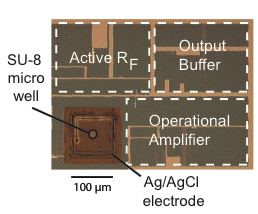
News coverage for our fast ion channel measurements!
A team of researchers at Columbia Engineering has used miniaturized electronics to measure the activity of individual ion-channel proteins with temporal resolution as fine as one microsecond, producing the fastest recordings of single ion channels ever performed. Ion channels are biomolecules that allow charged atoms to flow in and out of cells, and they are […]
2012
- (11/2012) Ferric Semiconductor in the news
- (7/2012) Congratulations for Mike Lekas for being a 2012 Qualcomm Innovation Fellowship winner.
- (3/2012) Jacob Rosenstein’s Nature Methods paper on high-speed nanopore-CMOS bioelectronic interfaces gets press attention: EurekAlert, Bio-Medicine, Physorg.com, IEEE Spectrum, Nature Methods News & Views, GenomeWeb
- (3/2012) Columbia University and SRC Breathe New Life into Scalability by Integrating Voltage Regulators Directly onto ICs
- (2/2012) EE Times talks about Noah Sturcken’s paper at ISSCC 2012.
2010
- (1/2010) Professor Shepard has been awarded $2.8 million from the DOE to develop energy-efficient computer chips. Read more at Columbia School of Engineering, EE Times, Columbia Research News
2009
- (5/2009) Matt Johnston explains on-chip mass sensors to Forbes.com in a short segment highlighting breakout technologies. See video
- (5/2009) Professor Shepard is quoted in Discover Magazine, June 2009 issue.
2008
- (12/2008) Inanc Meric presented his paper “RF performance of top-gated, zero-bandgap graphene field-effect transistors” in the 2008 International Electron Devices Meeting in San Francisco.
- (11/2008) Congratulations to Inanc Meric, whose paper “Current saturation in zero-bandgap, top-gated graphene field-effect transistors” has just appeared in Nature Nanotechnology.
- (10/2008) Columbia will receive $4 million to develop and evaluate graphene for use in field-effect transistors (FETs). Prof. Shepard is the PI on the grant.” details
- (7/2008) Columbia has been award a new $3M IGERT training grant by the National Science Foundation, “Optical Techniques for Actuation, Sensing, and Imaging of Biological Systems.” Prof. Shepard is the PI on the grant and will be directing the IGERT program.
- (6/2008) Prof. Shepard is named a finalist in the 2008 Blavatnik Awards for Young Scientists given by the New York Academy of Sciences. details
2007
- (11/2007) Prof. Ken Shepard has been elected a Fellow of the IEEE.
- (10/2007) Congratulations to Leina Lei for having her paper accepted to the 2008 International Solid-State Circuits Conference.
- (6/2007) Congratulations to Zheng Xu, Peter Levine, and David Huang for having four papers accepted to the 2007 Custom Integrated Circuits Conference.
- (4/2007) Congratulations to David Schwartz for having his paper accepted to VLSI Symposium 2007
2006
- (8/2006) Congratulations to Yee Li (Ph. D., 2005, now at Intel) for winning the ISLPED Low Power Design Contest for his Ph. D. work on low-power DSPs.
- (6/2006) Congratulations to Steven Chan (Ph. D., 2005, now at IBM Watson) for winning IBM’s 2005 Pat Goldberg Memorial Best Paper Award for his January, 2005 paper “Uniform-phase, uniform-amplitude resonant-load global clock distributions”, published in the IEEE Journal of Solid-State Circuits.
- (3/2006) Prof. Ken Shepard has been recognized as a 2005 Distinguished Professor by the New York State Office of Science, Technology, and Academic Research (NYSTAR).
2005
- (1/2005) EE Times article on our ISSCC 2005 paper on resonant clocking
- (1/2005) Resonant clock work featured on IBM Research’s home page
- (9/2005) EE Times article discussing our contributions to Cadence’s Assura RCX-PL product
2003
- (12/2003) R&D Magazine article in the December, 2003 issue discussing our active CMOS biochip research
- (12/2003) R&D Magazine article in the December, 2003 issue discussing our on-chip sampling oscilloscope designs (see inset)
1999
- (1/1999) Electronics Times article on CadMOS Design Technology. CadMOS, co-founded by Prof. Shepard, was acquired by Cadence Design Systems in 2001.

